Quick Answer
A panel interview is one candidate and two or more interviewers in the same session, usually taking turns to ask questions.
- In structured panels, each panelist often scores your answers separately against the job's requirements, so someone writing while you talk is normal.
- Ask the recruiter who is on the panel, then plan for what each person cares about.
- Answer the person who asked, look around the whole panel, and finish with the person who asked.
- Send a separate thank-you note to each panelist. The HideJobs job tracker keeps each panelist on the interview round, and its AI Assistant drafts a thank-you email to each one.
What a panel interview is (and how it differs from a group interview)
A panel interview puts you in front of two or more interviewers at once. They usually take turns asking questions, and they often come from different parts of the organization: the hiring manager, a future teammate, someone from HR, sometimes a person from a team you would work with closely. North Dakota State University's career center says employers often use panels when a role involves several teams or stakeholders.
A group interview is a different format. The University of Connecticut's career center defines it as "two or more candidates interviewing for the same position." In a panel, you are the only candidate, and several people judge you. In a group interview, you sit with other candidates. Some group interviews have candidates "solve a problem collectively to evaluate your teamwork and communication skills," which needs a different kind of preparation from answering questions alone. If the invitation is vague, ask the recruiter which one it is.
How a panel scores your answers
The biggest difference from a one-on-one interview is how the decision gets made. The US Office of Personnel Management, which writes hiring guidance for federal agencies, says on its structured interviews page that these interviews "are usually scored by a panel in which each member rates applicant responses individually." OPM's guidance favors questions built on the specific competencies the job needs, and in the most structured interviews every candidate gets the same questions, scored against "benchmarks of proficiency."
Private employers vary, and not every panel uses a formal rubric. Still, preparing as if each panelist is scoring you helps either way:
- Say the requirement out loud. A panelist with a score sheet is listening for evidence of a skill from the job description. If the job asks for stakeholder management, use those words and give a real example, so nobody has to guess what your story was meant to show.
- Answer the question you were asked. In a structured interview, each question is built around a competency from the job, so a great story about a different skill may not answer what that question checks.
- Expect note-taking. Illinois's civil service interview tips say interviewers are "recording their reaction to your responses, usually in accordance with some established guidelines." Someone looking down at a form is doing their job.
- Every panelist counts. The quiet person in the corner may hold the same score sheet as the hiring manager.
How to find out who is on the panel
Knowing who is on the panel changes how you prepare, and career centers recommend asking. UConn's career center says to find out who will be on the panel ahead of time, if possible, and NDSU's says it is fine to ask how many people will be there. A short message is enough:
If the recruiter does not share names, check the calendar invite, which often lists every attendee. Once you have names, look up each person's role and team. You want to know what each one is likely to care about, not their personal history.
In the HideJobs job tracker, add the round to the job's Interview tab so the panel lives next to the job description you are preparing from:
- Pick Panel Interview from Select stage... and set the date, start, and end time.
- Click Add Interviewer for each panelist and fill in their name and Title / Role. Add their LinkedIn and email if you have them: the round links to the profile, and the email lets you send the thank-you note from your mail app. People already saved on the job appear under Add existing contact....
- Use the job's Notes tab for what you learned about each person and the questions you want to ask them.
The round then shows each panelist's name and role, with a link to their LinkedIn profile, and the interview appears in the Next 7 Days calendar on the Dashboard once it is within the week. Add panelists while the round is still open, before you tick it as done.
How to prepare for a panel interview
On a panel, each person usually listens for a different part of the job, so you are preparing for several sets of concerns at once. Write down each panelist's role and guess what they will want to know:
- The hiring manager wants to know whether you can do the work and how you handle priorities.
- A future teammate wants to know what you are like to work with and how you handle detail.
- HR or a recruiter often covers motivation, logistics, and how you fit the team's way of working.
- Someone from a partner team wants to know how you communicate and handle disagreement across teams.
Then pick one or two stories from your experience for each of those concerns. With several people asking, short, ready answers help more than long ones. UConn's career center says to "take the time you need to respond while getting to the point quickly." Read the job description again the day before and mark its main requirements. OPM's guidance favors structured interview questions built on the competencies the job needs, so those are your likely topics.
Ask the recruiter whether the panel expects a presentation or a task, so it does not come as a surprise. Bring enough copies of your resume for everyone if the panel is in person. NDSU's career center says knowing the panel size lets you plan "the number of resumes or references that you bring."
Common panel interview questions
Panels ask the same kinds of questions as other interviews, but each one may come from a person with a different angle. Expect a mix like this:
- Opening questions: "Tell me about yourself", "Why are you interested in this role?", "What do you know about our company?"
- Behavioral questions: "Describe a situation where you had to deal with a difficult coworker", "Give an example of how you handled a tight deadline", "Tell me about a time you made a mistake at work."
- Role questions: how you would approach a task in the job description, often from the panelist who would work with you most.
- Cross-team questions: how you work with people outside your team, often from the panelist representing that team.
- Follow-up probes: OPM describes structured interviews as using pre-set lead questions and probes, which are follow-up questions. If someone asks "What did you do next?" or "What was the result?", they may be filling in their score sheet.
In HideJobs, the AI Assistant tab on each tracked job drafts answers to these for that specific job. Screening Call starts with "Tell me about yourself" and the other opening questions. Behavioral Questions writes answers in a STAR(L) structure: situation, task, action, result, and what you learned. Both use your resume plus the job's AI summary and keywords, so the drafts draw on the requirements in that job. Use Add question for anything you expect from a specific panelist, then rewrite each draft in your own words so it sounds like you when you say it out loud.
How to handle the room: eye contact, follow-ups, and difficult panelists
Keeping eye contact with everyone is hard when you are also trying to think. Illinois's civil service guidance gives a method: "Respond initially to the interviewer who asked the question," then "scan from one pair of eyes to the next, pausing briefly on each." In practice:
- Start with the person who asked. Look at them for your first sentence.
- Include the others in the middle of your answer. Move your eyes to each panelist for a moment while you give your example. UConn's career center suggests turning your shoulders to face the other interviewers as you go on, "to show that they have your attention."
- Finish with the person who asked. Then they know the answer is complete.
- Connect answers. NDSU suggests referring back to earlier comments or questions. "Building on what Priya asked earlier about deadlines..." shows you were listening to the whole panel.
Some situations are harder:
- A panelist who never looks up. They are probably taking notes on your answers. Include them when you scan the room, but do not try to win their attention. Illinois's guidance says to "try to ignore note-taking by the interviewers."
- A skeptical or tough questioner. Treat the challenge as a request for more evidence. Give one more concrete detail, stay calm, and do not argue. The rest of the panel is watching how you handle pressure.
- Two questions at once. Say which one you will answer first, answer it, then turn to the second person: "Let me start with the budget question, then come back to the timeline."
- Being cut off mid-answer. If the rest of your point matters, say so briefly: "Can I finish one thought on the last question first?" If it does not, let it go and answer the new question.
- A question you did not understand. Ask the person to repeat or rephrase it. A good answer to the right question scores better than a quick answer to the wrong one.
- Feeling outnumbered. Illinois's advice is to "think of the group as one person and try not to be intimidated."
Video panel interviews
On a video call you cannot make eye contact with one person, so names take over that job. Before the call, check the meeting invite for every attendee. When the call starts, match each name on the screen to a role from your notes.
- Use gallery view so you can see everyone, and keep it near the top of your screen so your eyes stay close to the camera.
- Say names to direct an answer. "Good question, Sam" at the start tells the panel who you are answering. If you include someone else, name them: "and Maria, this connects to the project you mentioned."
- Look at the camera for your main points. On video, looking at the lens is the closest thing to eye contact with the whole panel at once.
- Expect silent cameras. A note-taker may turn their camera off or look away to type. It means the same as note-taking in the room.
- Leave a short pause before you answer. Delays on a call make it easy to talk over someone, and on a panel there are more people to talk over.
Oral board interviews for government and police jobs
An oral board is a panel interview used for many public-sector jobs, including police officer roles. Illinois's State Universities Civil Service System, whose interview tips cover its Police Officer Series oral boards, says you "will be asked standard job-related questions" and should expect interviewers to take notes as you speak. It also says to arrive at least 25 to 30 minutes early.
At some agencies the oral board score is part of your ranking. Colorado Springs Police says "written test scores and oral board scores will be combined to determine banding," so your board score affects which band you are placed in.
In a structured, scored board like these:
- Every candidate gets the same questions, so a vague answer cannot be rescued by chatting. Your answer is scored against the same standard as everyone else's.
- The panel may be busy writing. Judge yourself by what you said, not by how often they look up.
- The job announcement is your study guide. Illinois says to "obtain and study the job announcement/job description to determine the employer's expectations." The questions are job-related, so each listed duty is a likely topic.
- Answer fully even when it feels obvious. A panelist can only score what you actually say.
Some agencies publish guides for their own oral boards. If yours does, read it first: it describes how that agency runs its boards.
Questions to ask in a panel interview
Most panels end with time for your questions, and the most useful ones are aimed at what each panelist does:
- To the hiring manager: "What would a successful first six months look like in this role?"
- To a future teammate: "What does a normal week on the team look like, and where would this role help most?"
- To a partner team member: "How does your team usually work with this role, and what makes that go well?"
- To HR or the recruiter: "What are the next steps, and when do you expect to decide?"
UConn's career center says to "ask questions of each of the interviewers at the end of the interview." If time is short, ask at least two different panelists, so the questions do not all go to the most senior person. Always ask about next steps and the timeline. You need that date to know when a follow-up is due.
After the panel: thank-you notes to each interviewer
Write a separate thank-you note to each panelist. UConn's career center says to send "a unique thank-you note to each of them within 24 hours of the interview," because panelists may compare notes. Copies with only the name changed look careless when they sit side by side. Mention something each person asked or talked about, and add one point you did not get to say.
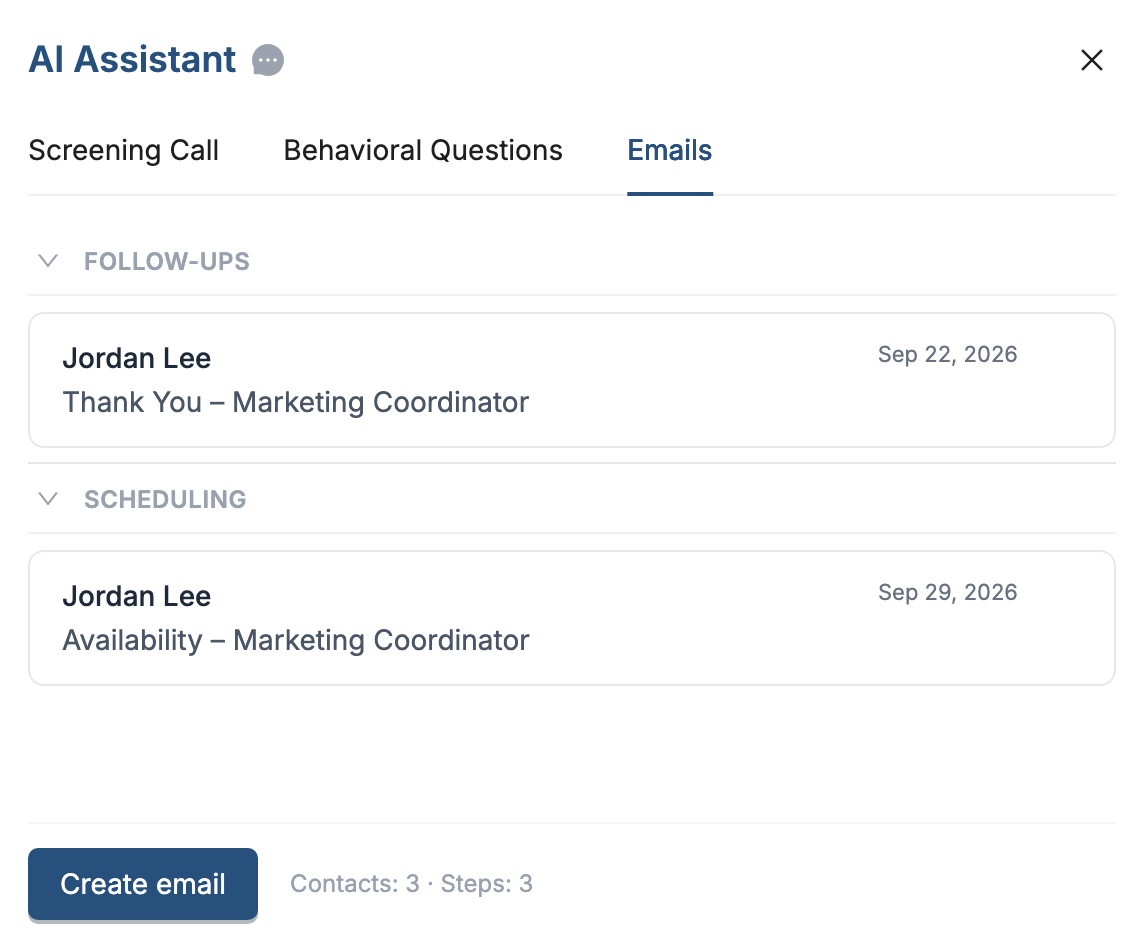
In HideJobs, open the job's AI Assistant tab, go to Emails, and click Create email. Select a panelist, choose Follow-up and the Thank the interviewer(s) focus, then pick the panel round. Add what you want mentioned under Extra details, then click Write with AI. Each email goes to one contact, so you write one per panelist, each with its own details. If the contact has an email address, open the draft in your mail app to send it.
Once the round's time has passed, it shows Follow up! until you tick the Follow up checkbox next to its date and time, so tick it when your notes are sent, before you mark the round done. For templates, including one for a single panelist out of several, see follow-up emails after an interview.
If you missed a name
Check the calendar invite first. If that does not help, thank the recruiter and ask them to pass your thanks to the panelists, or ask for their names.

Anton writes about job search problems from firsthand experience. He builds tools to solve issues like repeated listings, irrelevant results, and inefficient filtering across job platforms.
Related Resources:
- Follow-Up Email After an Interview: Templates and Timing - When to send each follow-up, with short templates to copy
- Job Application Tracker: What to Track and How to Set It Up - Keep every application, interview, and follow-up in one place
- Job Search Burnout: How to Stay Organized and Keep Going - How to keep going when the search drags on