Quick Answer
ATS (Applicant Tracking System) software ranks resumes by keyword match, not formatting. To pass it, your bullet points need to mirror the language in the job description, start with past-tense action verbs, and include at least one number or concrete result per bullet.
What ATS actually does with your resume
Most job seekers picture ATS as a locked gate that either lets a resume through or rejects it outright. That is not how it works. ATS software is a database that organizes incoming applications and scores them based on how well they match the job posting. A recruiter still reads the top-ranked resumes. Your goal is to rank highly enough to be in that group.
The scoring is largely keyword-based. The system looks for the specific titles, skills, tools, and phrases the hiring team wrote into the job description. If your resume uses different words for the same thing, for example "supervised" when the posting says "managed," it may rank lower even if your experience is directly relevant.
When a resume scores low, it sits at the bottom of the recruiter's queue. Not rejected outright, but effectively invisible. Recruiters work through the top of the list and stop when they have enough candidates to interview. If your resume is not near the top, it is unlikely to be opened.
The fix is not to game the system. It is to write bullets that accurately reflect what you did, using the same vocabulary the posting uses.
Why most bullet points fail the ATS ranking
The most common failure is writing bullets that describe job responsibilities rather than personal accomplishments. Responsibilities are what anyone in that role was expected to do. Accomplishments are what you specifically delivered. ATS ranking aside, a recruiter spending 30 seconds to a minute reviewing your resume will not slow down for a list of duties. Concrete results give them something to stop on.
Responsibility vs. accomplishment
- Responsibility: Managed social media accounts for the brand
- Accomplishment: Increased Instagram engagement by 47% in 6 months by redesigning the posting schedule and shifting to short-form video
The second common failure is using generic language that does not appear in the job description. If the posting asks for someone who can "build cross-functional relationships" and your bullet says "worked with different teams," the ATS may not connect those two phrases. The safest approach is to use the exact phrase from the posting when it naturally fits.
A third issue is burying results at the end. The strongest part of any bullet is the outcome. "Reduced onboarding time by 40%" should come early in the sentence, not as an afterthought. ATS systems that weight term frequency will give more credit to prominent keywords; recruiters scanning quickly will notice a number at the front of a line faster than one tucked into the middle.
The formula for a strong bullet point
A simple four-part structure produces bullet points that work in both ATS ranking and human review: a past-tense action verb, what you did, a metric, and the result or impact. Not every bullet needs all four elements, but the more specifically you can fill them in, the stronger the bullet becomes.
The formula
Action verb + what you did + metric + result
- Organized a charity event for 300 attendees, achieving full capacity and raising $500,000 in a single evening.
- Implemented a new payroll and tax system across 12 offices, saving the company $2M over 5 years.
- Reduced weekly code review time by 30% by introducing automated tooling, increasing engineering team output by 20%.
- Conducted compliance training for 100+ managers across 5 locations, cutting company expenses by 50% through process standardization.
Use past-tense verbs even for a current role. It reads more cleanly and is standard practice. Start every bullet with a different verb where possible: "Implemented," "Led," "Built," "Reduced," "Increased," "Designed," "Launched." Repeating the same verb at the top of every line weakens the overall impression.
If you are struggling to find numbers, work through these questions for each role:
- Did you generate additional revenue or help the company save money?
- Did you improve or speed up a process?
- Did you implement a new system or procedure?
- Did you train, mentor, or manage people? How many?
- Did you reduce errors, improve retention, or increase customer satisfaction?
- Did you deliver something in less time or with fewer resources?
- Did you find new clients or expand into a new market?
The hardest part for most people is the metric. Once you start looking, you usually find more than you expected: a team size, a budget figure, a timeline improvement, or a volume of output. If a specific number is not available, describing scale in concrete terms is still much stronger than no context at all.
How to find the right keywords for each application
The keywords that matter most in any given application are the ones the hiring team chose to put in the posting. They wrote the description to describe the person they want. Your job is to show that your experience maps onto that description using their own language.
Read the job description carefully before writing or revising any bullet. Look for three categories of terms:
Three keyword categories to find in every posting
- Hard skills and tools: specific software, platforms, certifications, methodologies (Salesforce, Python, Agile, PMP, SQL)
- Soft skills used in context: phrases like "cross-functional collaboration," "stakeholder communication," or "data-driven decision making" that appear in the responsibilities section
- Job title and seniority signals: the exact job title, whether the role is described as "senior," "lead," or "manager," and any department names
Matching the exact title language from the posting in your resume is one of the most effective changes you can make. If the role is called "Senior Product Manager" and your resume says "Product Lead," the ATS may not treat those as equivalent.
You do not need to insert every keyword you find. Stuffing terms in unnaturally reads poorly and will not help once a recruiter opens the document. The goal is that the 5 to 10 most important terms from the posting appear at least once in your resume, in context, within bullets where they genuinely fit.
One practical approach is to copy the job description into a text editor and highlight every skill, tool, and phrase that appears in the requirements or responsibilities sections. Then go through your existing bullets and check which of those highlighted terms are present, absent, or present but phrased differently. Fix the gaps and update the phrasing where needed.
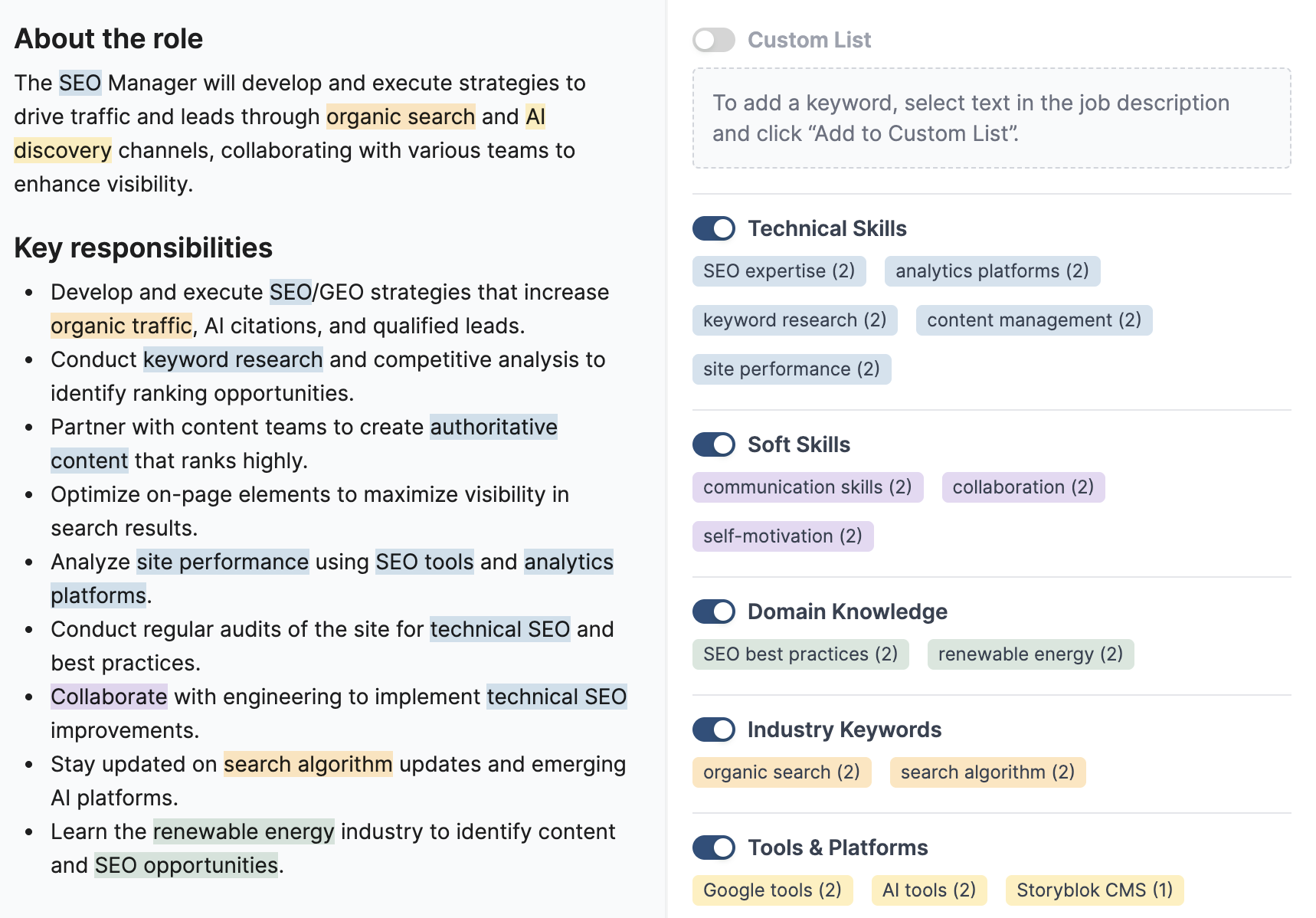
If you track the job in the HideJobs job tracker, the AI does this extraction for you. It reads the job description and pulls out the keywords grouped by category: technical skills, soft skills, domain knowledge, industry terms, and tools. Each keyword shows how many times it appears in the posting, so you can prioritize the ones that matter most.
How many bullets each job needs
Not every job on your resume needs the same number of bullets. The principle is that recent and relevant experience should get the most space, and older or less relevant roles should get less.
Bullet count by role
- Most recent and most relevant job: 3 to 5 bullets
- Other recent jobs: 2 to 3 bullets
- Older or less relevant roles: 0 to 2 bullets, or just the title and dates
Be selective. A resume with 8 weak bullets for one job is harder to scan than one with 4 strong ones. Every bullet you include is competing for the recruiter's attention. If a bullet does not include a real accomplishment or a keyword that matters for this specific role, it is probably taking up space that a stronger point could fill.
For each application, it is worth reordering your bullets so the most relevant ones appear first within each role. Recruiters who are skimming will often read the first bullet and move on. Put your best match for this specific posting at the top of the list.
A faster way to write tailored bullets
Tailoring bullets for every application takes time. Reading the job description, identifying the right keywords, rewriting each bullet to include the result and the matching language, and then reviewing it all is a 15 to 20 minute process per application done carefully. The HideJobs resume builder has an AI bullet point assistant built in to make this faster without cutting corners.
The AI generates three options for each bullet you want to write or improve. Each option applies the action verb plus result formula, uses ATS-friendly language, and incorporates context from your role. You choose the version that fits best, or use it as a starting point and edit from there.
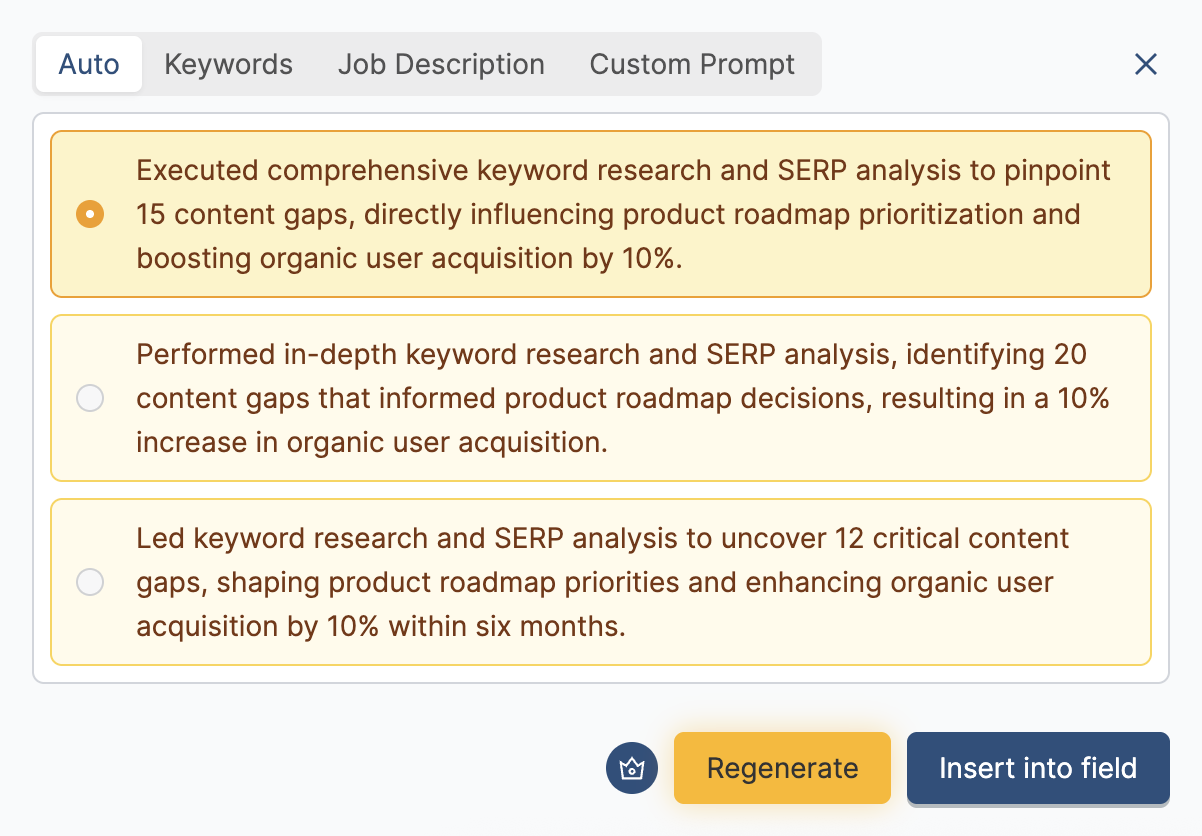
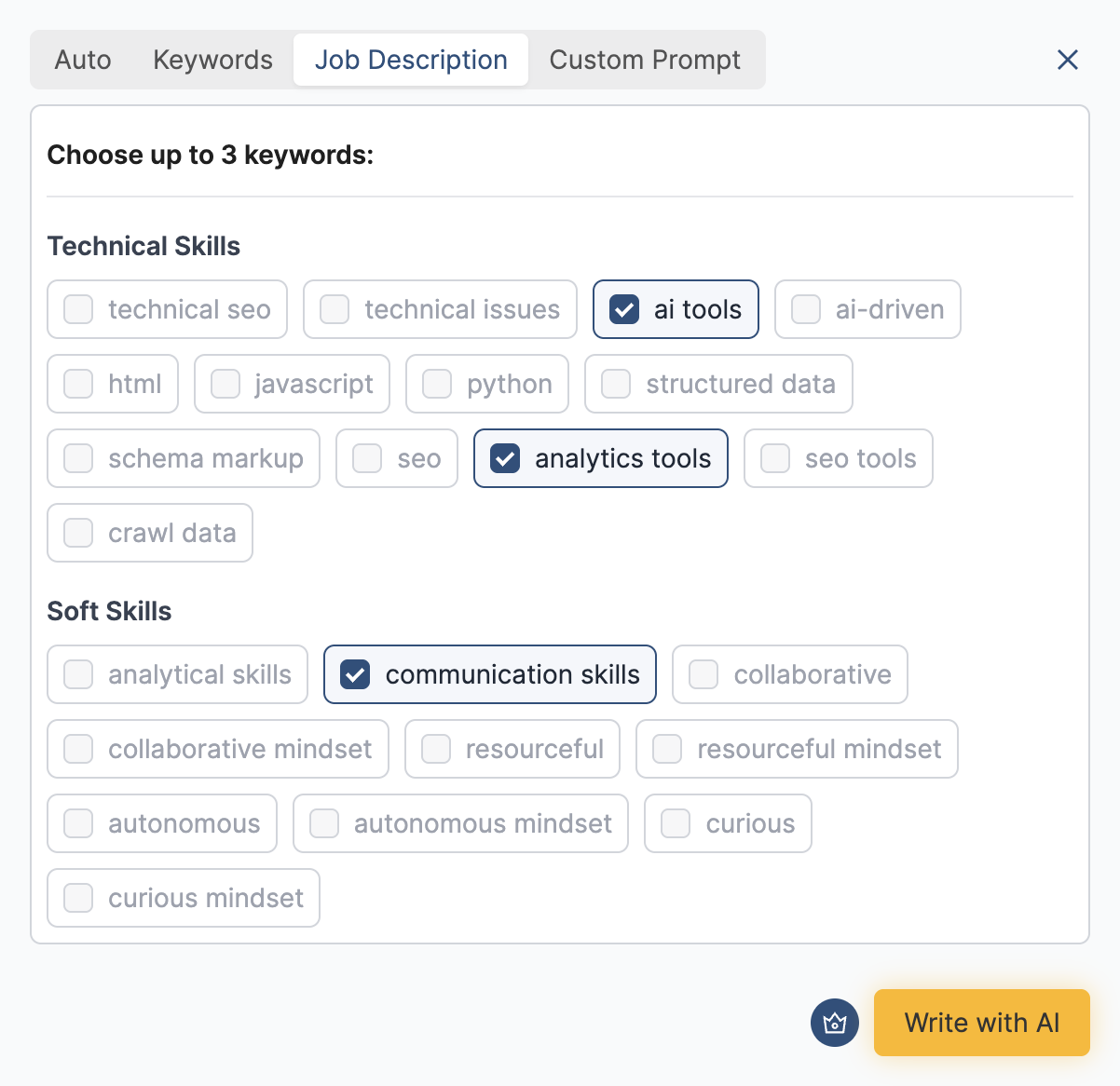
The most useful mode for ATS alignment is Job Description. When you analyze a job posting in the HideJobs job tracker, the AI extracts the key skills and requirements from that posting automatically. Those keywords then appear as checkboxes in the resume builder. You pick the ones most relevant to the bullet you are writing, and the AI weaves them in naturally.
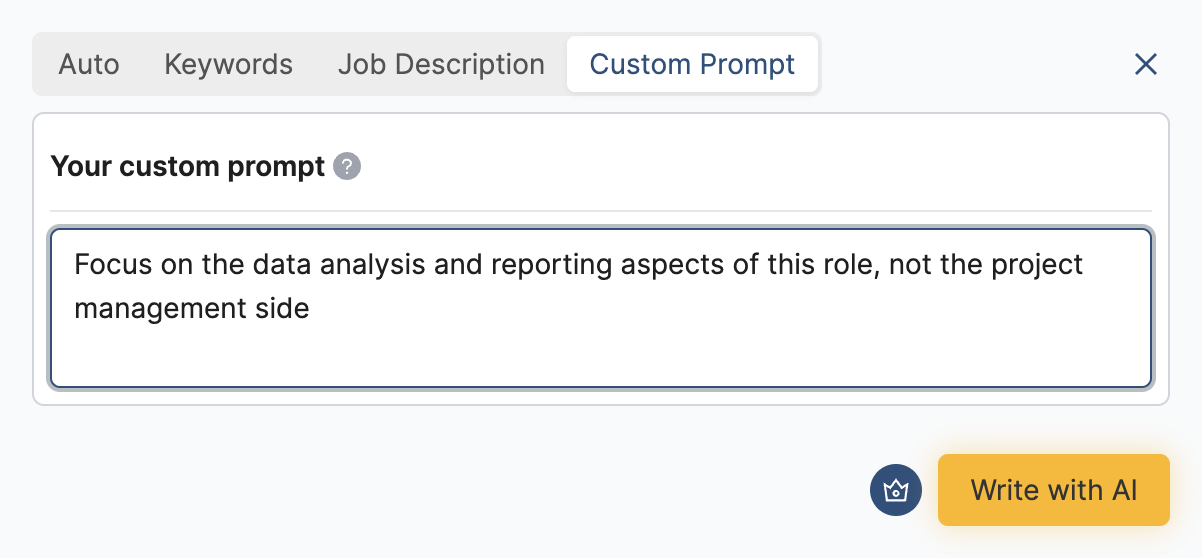
If you need to steer the output toward a specific angle (for example, to emphasize one part of a role over another), the Custom Prompt mode lets you give the AI a plain-language instruction. The result still follows the action verb plus result formula, but shaped around what you told it to focus on.
You can try all modes at the HideJobs resume builder.

Anton writes about job search problems from firsthand experience. He builds tools to solve issues like repeated listings, irrelevant results, and inefficient filtering across job platforms.
Related Resources:
- How Many Jobs Should I Apply For? - How to think about application volume so you spend your time on searches that actually go somewhere
- LinkedIn Easy Apply vs. Applying Directly - What happens to your resume through each channel and when direct applications are worth the extra effort
- Should You Apply to Jobs with 100+ Applicants? - When high-competition listings are worth your time and when to skip them
- HideJobs Resume Builder - Build your resume with AI-assisted bullet points tailored to each job description