Quick Answer
It depends on how urgently you need to move:
- Need a job within a month: ~25 targeted applications per week
- Two to three months: 10-15 per week
- Up to six months: fewer, but more selective and researched
- Currently employed: 5-10 per week at a comfortable pace
In every case, a tailored application beats a generic one. Volume only helps when the quality is there.
How many jobs should you apply for?
Most job search advice frames this as a numbers game. Send more, hear back more. But that is only true up to a point. Once you are sending applications faster than you can tailor them, the extra volume stops helping.
The better question is: how many can you apply to well this week? For most people that is somewhere between 10 and 15. It is enough to keep momentum going and have real options in play, without rushing through each one.
If you are applying to 30 or 40 jobs a week and not hearing back, the problem is almost never that you need to send more. It is that the applications are not connecting. More of the same will not fix it.
The right number depends on your situation
The right number is not the same for everyone. The most important factor is how urgently you need to move. Someone who just lost their job is in a different situation than someone quietly exploring options while employed.
You need a job within a month
Apply to around 25 targeted roles per week. That means treating the search like a full-time job: spending time every day finding relevant postings and submitting strong applications. You cannot afford to be passive, but you also cannot afford to send sloppy ones. Every application still needs to connect.
You have two to three months
Around 10-15 per week is a comfortable pace. You have enough time to tailor each application properly and do research on the companies you are interested in. This range lets you build a real pipeline without sacrificing quality.
You have up to six months
You can afford to be selective. Focus on roles that genuinely excite you, research companies thoroughly before applying, and invest time in networking alongside applications. Quality matters more than cadence here. Do not wait too long to start, though. Hiring processes take time regardless of when you apply.
You are currently employed
You have the luxury of being patient. Apply to fewer roles but make each one count. You do not need to burn yourself out sending a dozen applications a week when you have a paycheck coming in. A steady pace of 5-10 thoughtful applications per week is enough to keep things moving without it taking over your evenings.
Is it better to apply to more jobs or tailor each one?
A resume tailored to a specific role uses the same language as the job description, highlights the experience that is actually relevant, and makes it easy for a recruiter to see the match in a few seconds. A generic resume makes them work to find it, and most will not bother.
That does not mean rewriting your resume from scratch for every job. It means spending 10-15 minutes adjusting the summary, reordering bullet points, and making sure the skills they listed are visible in your application. That time pays off.
It also means being selective about what you apply to in the first place. High-competition listings with hundreds of applicants are harder to stand out in regardless of how good your resume is. Prioritizing roles where you are a strong fit on paper gives you better odds before you have even written a word.
What does a realistic job search week look like?
Most people underestimate how long a good application actually takes. If you account for reading the job description carefully, adjusting your resume, and writing a cover letter, you are looking at 20-30 minutes per application minimum.
A workable weekly structure looks something like this:
Finding and shortlisting roles
Use keyword filtering to cut through noise quickly. Save more roles than you plan to apply to: bookmark 15-20 that look interesting, then apply to the strongest 10-15. Separating browsing from applying keeps you from rushing decisions.
Writing and submitting
Apply to your shortlisted roles one at a time. Try to apply within the first 72 hours of a posting going live. Recruiters are most active early, and applications submitted in the first few days get more attention than those that arrive a week later. Apply directly on the company's website where possible rather than through a third-party board.
Following up
Check in on applications you sent 5-7 days ago. If you have connections at a company you applied to, reach out. A warm introduction does more than another application ever will.
Does the ATS automatically reject your resume?
There is a persistent myth that applicant tracking software automatically screens out most resumes before a human sees them. It is not true. ATS software organizes and ranks applications. A recruiter still reviews the shortlist and decides who to contact.
What does matter is that your resume is easy to read quickly. Use the same job title language as the posting. List the skills and tools they asked for. Keep the formatting clean and straightforward. That is not "beating the ATS." It is just writing a resume that makes sense.
What actually helps:
- Using the same terminology as the job description
- Putting the most relevant experience near the top
- Avoiding tables, text boxes, and headers that do not parse well
- Keeping it to one or two pages
What to do when your applications are not getting responses
If you are not tracking your applications, you are flying blind. After a few weeks it becomes hard to remember what you applied to, when, and what happened. You also cannot spot patterns: which types of roles get responses, which companies go silent, whether a particular version of your resume is performing better.
The simplest thing you can do is log each application as you send it: role, company, date, and current status. Once you have a few weeks of data, you can see clearly where things are stalling and whether your weekly pace matches the timeline goal you set for yourself.
One practical way to do this without extra effort is to use the HideJobs job tracker. When you apply through LinkedIn, the browser extension detects the application automatically and adds it to your tracker without you having to do anything. On other platforms you can save a job in one click from the extension panel — it pulls the job title, company, and location from the page so you are not copying anything manually.
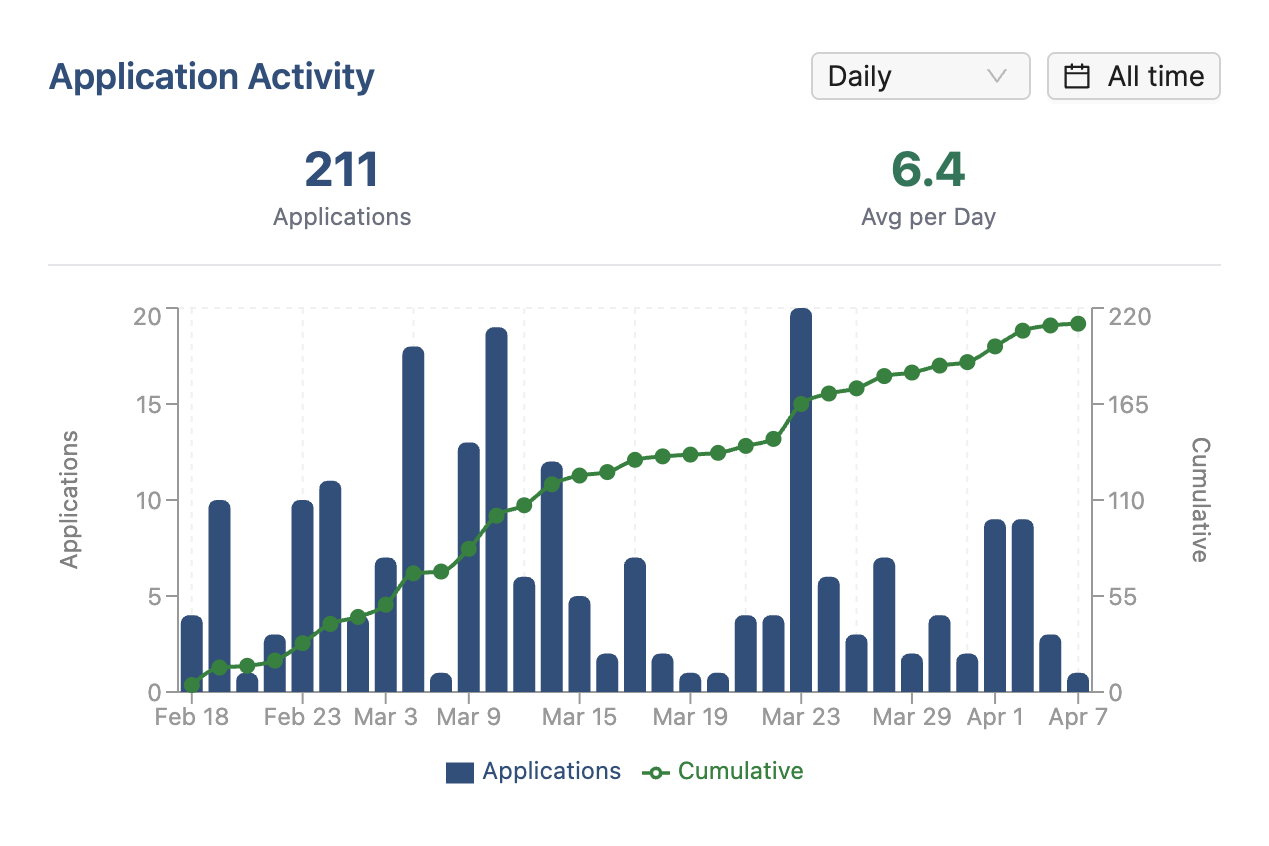
When I was job searching I had no idea what my actual pace was. I felt busy, but I could not tell you how many applications I had sent that week or what my average was. That is the main reason I built the Application Activity chart into the tracker. I wanted the real number, not a guess.
Once your applications are logged, the chart shows you how many you sent each day or week and your cumulative total over time. If you set yourself a target of 15 per week and the chart shows you averaging 6, that is useful to know before another month passes.
If you are sending applications and hearing nothing back, that is a signal to stop and review, not to send more. Read back through the roles you applied to. Were they genuine matches, or were you stretching? Are the postings still active, or have they been live for months? Ghost jobs will absorb your effort without ever responding.
Signs something needs adjusting:
- No responses after several weeks: review your resume and whether the roles are a real fit
- Getting interviews but no offers: the problem is downstream, focus on interview preparation
- Heard nothing after an interview: follow up once, directly and briefly
- Low response from job boards: try applying directly on company career pages instead

Anton writes about job search problems from firsthand experience. He builds tools to solve issues like repeated listings, irrelevant results, and inefficient filtering across job platforms.
Related Resources:
- Should You Apply to Jobs with 100+ Applicants? - When high-competition listings are worth your time and when to skip them
- Ghost Jobs: What They Are and How to Spot Them - Avoid wasting applications on postings that will never hire
- Job Application Tracker - Track every application, interview, and follow-up in one place